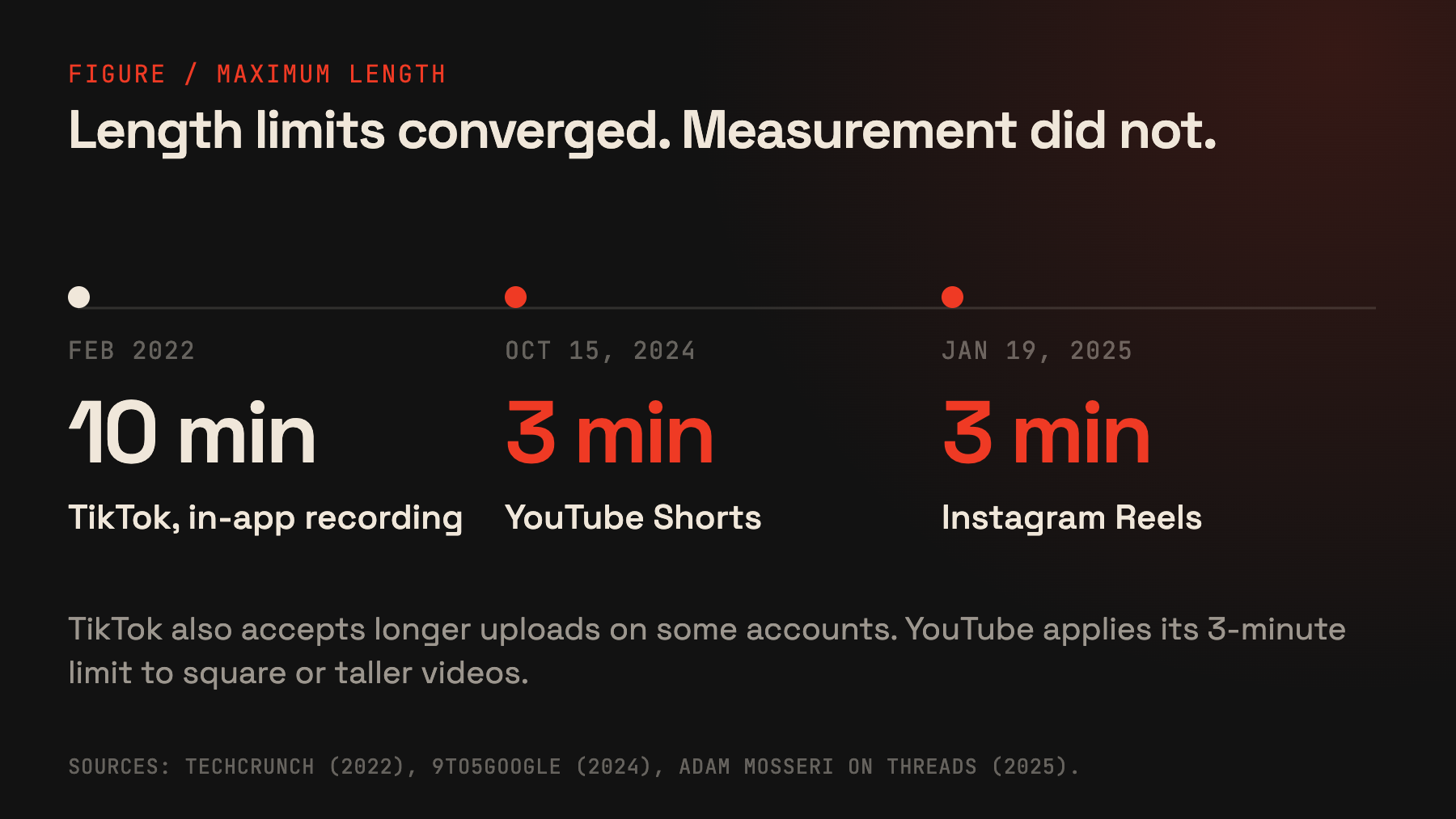
On October 15, 2024, YouTube let Shorts run for three minutes. On January 19, 2025, Instagram's Adam Mosseri announced that Reels could run for three minutes too. TikTok had allowed ten minutes in the app since February 2022. By the start of 2025, the three biggest vertical-video platforms accepted the same file, in the same shape, at roughly the same length.
If one file passes every gate, one edit should work in every feed. This essay tests that assumption, and the evidence says the gates converged while the judges did not.
Mosseri, announcing the change on Threads, framed it as giving creators "a bit more room to be creative."
Adam Mosseri on Threads, January 2025
A file can travel between platforms. The viewer's decision stays behind in each feed.
The rest of this piece is about what changes when the same recording lands in three different feeds, and what an editor should adjust in each. We edit for all three, which gives us an interest in the idea that one export is not enough. The sources are linked so you can judge the claim on its evidence.
The gates converged, the judges did not
Start with length. TikTok expanded its limit to 10 minutes in February 2022, up from three. YouTube extended Shorts to three minutes on October 15, 2024, for videos that are square or taller, and left older uploads alone. Instagram followed in January 2025, raising the Reels limit from 90 seconds to three minutes.
Now look at how each platform scores a video. Instagram added skip rate and a retention chart to Reels insights in August 2025, with skip rate counting views that left in the first three seconds. Mosseri has also said that watch time, likes per reach and sends per reach are the three signals that matter most, as summarised here.
YouTube reports viewed vs. swiped away for Shorts, and since March 31, 2025 it counts a view from the moment a Short starts playing, with no minimum watch time. The old measure survives as engaged views, which YouTube said still governs monetisation. TikTok has said that finishing a longer video is a strong indicator of interest, weighted above weak signals such as viewer and creator sharing a country.
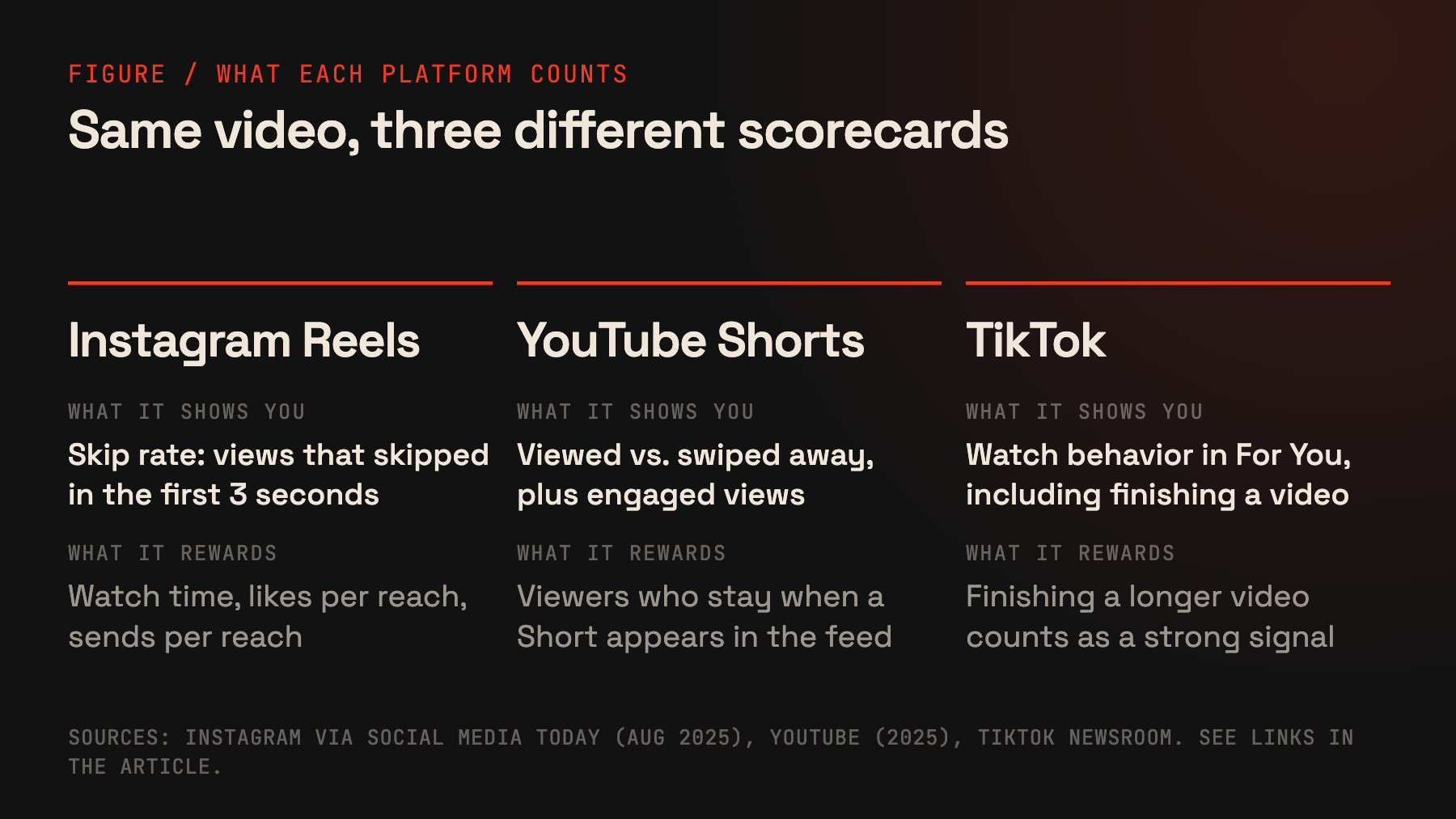
The pattern across the three is that a viewer's decision is read at different moments. Instagram counts the skip in the first three seconds and rewards the send. YouTube separates the swipe from the stay. TikTok leans on whether people finish. A file tuned for one of those moments can be average at the other two.
Knowing this does not stop the re-export
Most creators know the platforms differ. Most still export once and upload everywhere, and the reason is cost asymmetry. One export takes a minute and shows its price immediately. The price of the missing adjustment appears later, spread across a retention curve nobody compares against a counterfactual.
Platforms add their own pressure. In April 2024, Meta announced that Instagram would replace reposted Reels with the original version when it detects identical content, and that accounts posting unoriginal content ten or more times in 30 days would have their Reels removed from recommendations. That policy targets aggregators, so a creator reposting their own clip is not the intended subject, but it shows where distribution is heading: toward content that looks native to where it plays. Export a clean master with no platform marks on it and treat that file as the starting point for each feed.
Public numbers also stop being comparable. A Short with 10,000 views counts every play since March 2025, including quick scroll-bys. Put it next to a Reel with 10,000 views and you are comparing different definitions. Compare on engaged views, skip rate and swipe rate instead.
The interface sits on top of your edit
Every vertical app lays buttons, captions and account names across the picture. On a 1080 by 1920 canvas, the margins TikTok publishes in its ad template, as reproduced in third-party guides, work out to roughly 7% at the top, 25% at the bottom and 13% on the right edge. Instagram added a second constraint in January 2025 when it moved the profile grid to a vertical format: thumbnails now show the central 3:4 area, so the top and bottom 12.5% of a cover frame disappear on a profile.
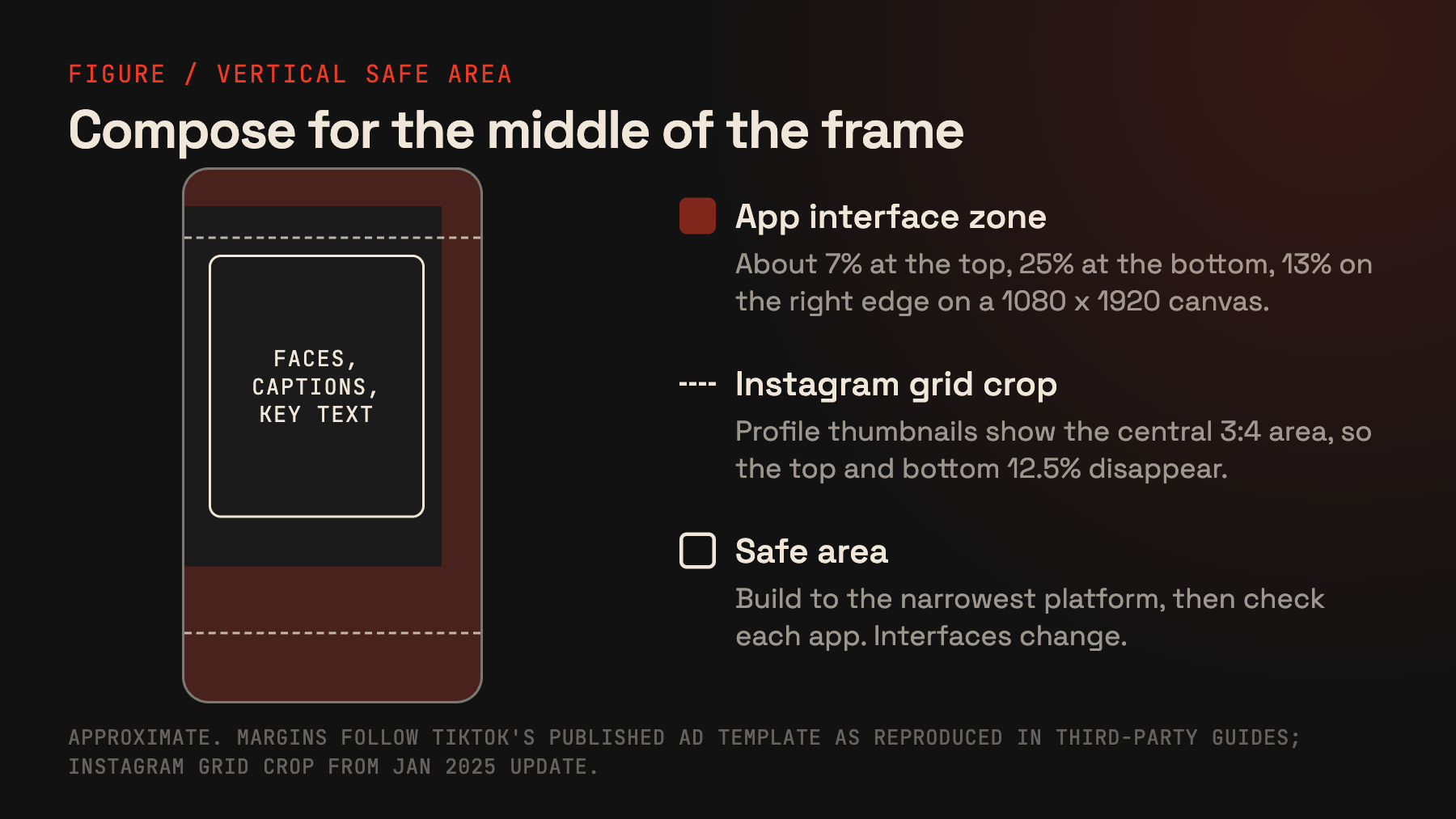
Captions share the same real estate. In 2016, Facebook reported from internal tests that captioned video ads increased view time by an average of 12%. That figure is a decade old and comes from ads on one platform, so read it as direction rather than size. The practical lesson from the safe area is that captions placed low in the frame will sit under the app's own text, and captions placed high will collide with the top bar.
Longer limits turn length into a choice
When the ceiling was 60 seconds, length was mostly settled for you. With three minutes available on Reels and Shorts and ten on TikTok, it becomes an editorial decision, and the evidence on it points one way. Wistia's 2026 State of Video report, covering more than 13 million videos, finds that shorter videos achieve higher engagement rates, and TikTok has said that finishing a longer video is a strong signal of interest. Combined, the two give a practical rule: every extra second has to pay for the completion it puts at risk.
That does not make short always right. A three-minute walkthrough can hold a viewer who wants the whole thing. It means length should follow the content. Our rule of thumb is that a single idea fits in 20 to 45 seconds, a story with a turn needs 60 to 90, and only a walkthrough that delivers something at every step earns the full three minutes. TikTok's emphasis on finishing makes it the least forgiving of padding, so when you are unsure where to cut, trim for TikTok first and let the other versions run slightly longer if the content earns it.
Three interpreters, one speech
With the evidence in place, the image that helps most is interpretation. The same speech can be given in three languages, and each interpreter changes more than the words. They adjust vocabulary, grammar, idiom and punctuation so the audience hears the speech as if it had been written for them.
- Vocabulary is pacing and length. Where the first cut lands, and how much dead air survives, depends on whether the platform reads the first three seconds, the swipe or the finish.
- Grammar is structure. A hook, promise and payoff ordering suits a swipe-driven feed. A tighter arc suits a platform that rewards completion.
- Idiom is audio and tone. What sounds native on one platform sounds borrowed on another.
- Punctuation is captions and framing. Where text sits, and what the grid crop will cut.
Here is what we change first for each platform. These are editing decisions drawn from the signals above, with no platform guarantee behind them.
| Platform | Change first | Ending | Watch |
|---|---|---|---|
| Instagram Reels | Tighten the first 3 seconds | A line worth sending to a friend | Skip rate, sends, cover frame at 3:4 |
| TikTok | Remove dead air to protect completion | A clean finish at the last payoff | Completion, caption position |
| YouTube Shorts | Make the first frame work as a swipe decision | A clean cut that invites a replay | Viewed vs. swiped away, engaged views |
Notice how little of that is a new edit. It is a first-three-seconds pass, an ending pass and a framing pass. A strong video hook does most of the work on every platform, which is why we put it first.
One 45-second clip, three exports
This is an illustrative walk-through and not a case study. Take a founder recording a 45-second explanation of why they raised prices. The master has a clean opening, a captioned middle and a closing line.
- Reels: the first sentence is cut from nine words to four so the claim lands inside three seconds, the cover frame is centred so the 3:4 grid crop keeps the face and the headline, and the last line is reworded into something a viewer would send to a friend in the same position.
- TikTok: a half-second pause and two filler phrases are removed, bringing the clip to about 38 seconds so more viewers reach the end, and captions move up out of the bottom quarter of the frame.
- YouTube Shorts: the opening frame becomes a close-up of the founder mid-sentence, because it has to work as a swipe decision by itself, and the ending is trimmed so the last word lands on the loop point.
The three versions share one recording and one export pipeline. What differs is a short pass on the opening, the ending and the framing, aimed at the specific number each platform reports. That is what we mean by tweaks rather than re-edits.
The case for posting the same file
A small team with limited hours has a fair argument. Three re-edits per recording can cost more than the extra performance returns, and the platforms are converging on similar formats, similar lengths and similar interfaces. A clean master with a strong opening and a respected safe area already clears most of the bar.
That argument is right about effort and holds up until the numbers disagree. The sensible middle is a universal master plus three small adjustments rather than three full edits. Re-cut properly only when one platform's skip or swipe rate lags the others, because that is the signal that the opening fails in that feed. The same logic applies to podcast clips, where one hour of conversation yields clips that each need only light platform tuning.
What to change, in order
- Export a clean master with no watermark or logo from another app.
- Check the safe area in each app's preview before scheduling.
- Re-cut the first three seconds wherever one platform's skip or swipe rate trails the others.
- Adjust the ending to the signal each platform rewards.
- Log results under each platform's own metric name so the comparison stays fair.
If you are comparing providers for this work, our guide to video editing companies shows what each offers.
If you are buying this work rather than doing it, our service pages on Instagram Reels editing, TikTok video editing and YouTube Shorts editing describe what each includes, and short-form video editing cost explains how the price is built.
Back to the room
Mosseri's phrase was "more room," and the platforms have given creators plenty of it. The viewers still sit in three separate rooms, each with its own way of keeping score, and the work of a good edit is to speak to each one without tripling your workload.
That is the job we take on. Tell us where you publish, send one recording, and we edit it for how those feeds measure a viewer: a first three seconds that earns the stay, an ending that fits the platform, and captions that sit inside the safe area. You get platform-ready exports in 48 to 72 hours, with two rounds of revisions and no contract. Our packs start at $220 for four videos, so you can see the difference on a handful of clips before committing to more.