Edison Research's Infinite Dial 2026 reports that 58% of Americans aged 12 and over listened to a podcast in the past month, and that 57% have both listened to and watched podcasts. Its summary of the video question is blunt: this is a dual-format medium now.
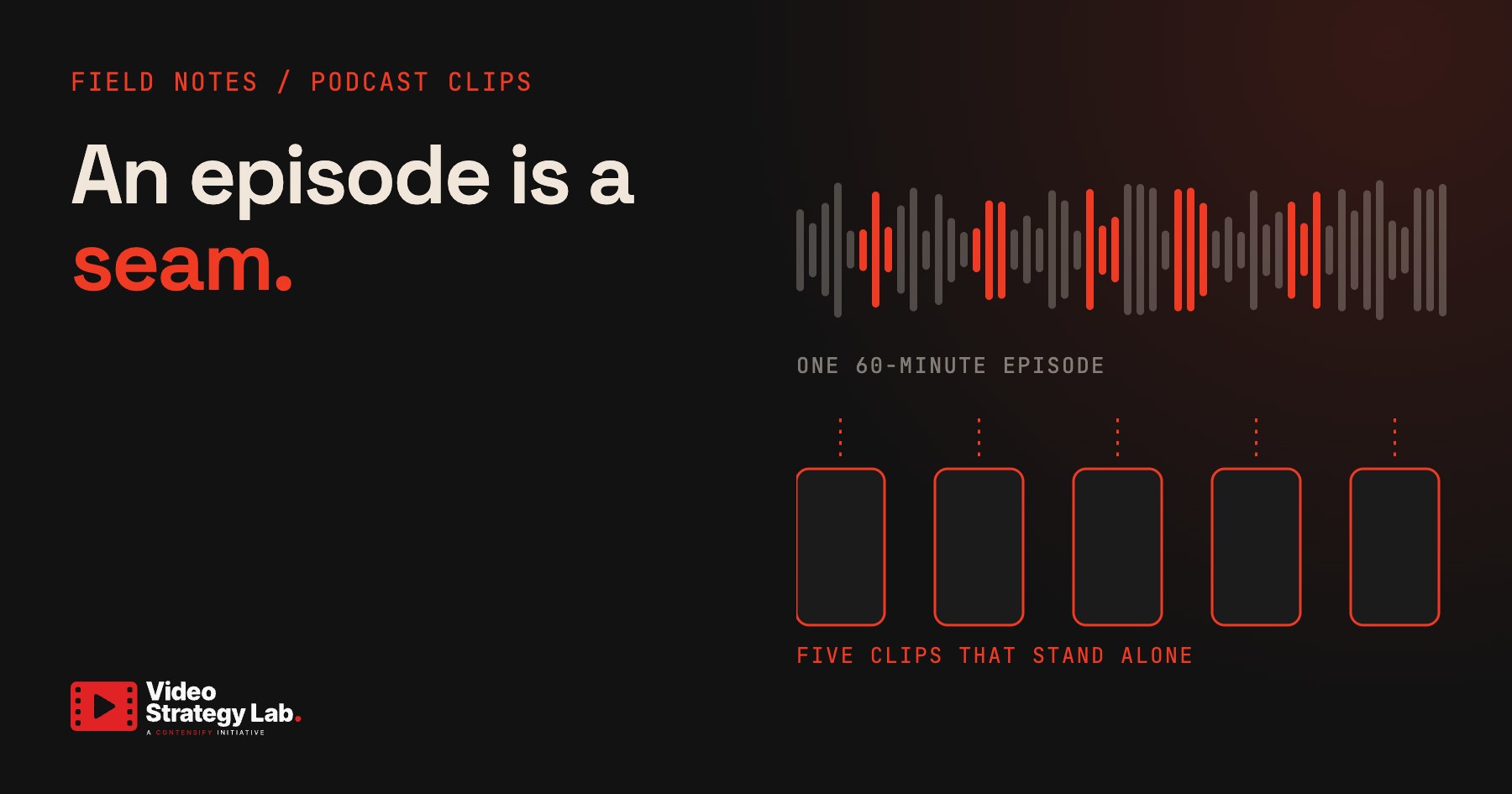
Podcasting has quietly become a video medium, and the episode most shows publish is a single long file with a title and a still image. Picture one: 62 minutes, exported as one recording. Somewhere inside it are a few stretches of 20 to 60 seconds that a stranger would stop for. The file does not say where they are.
An episode is a seam of ore, and clips are what you assay out of it.
The rest of this piece is a workflow for finding those stretches and turning them into short vertical video. We edit podcast clips for a living, so we have an interest in the claim that clips matter, and the sources are linked so you can check it.
Discovery moved to the feed
Coleman Insights and Amplifi Media surveyed 1,000 US consumers for The State of Video Podcasting 2025, published in April 2025. Social media led podcast discovery at 57%, ahead of friends and family at 54% and podcast apps at 49%. The researchers described it as the first time social media had taken the top spot. Among social platforms, YouTube led at 59%, followed by YouTube Shorts at 41%, Instagram Reels at 34% and TikTok at 29%.
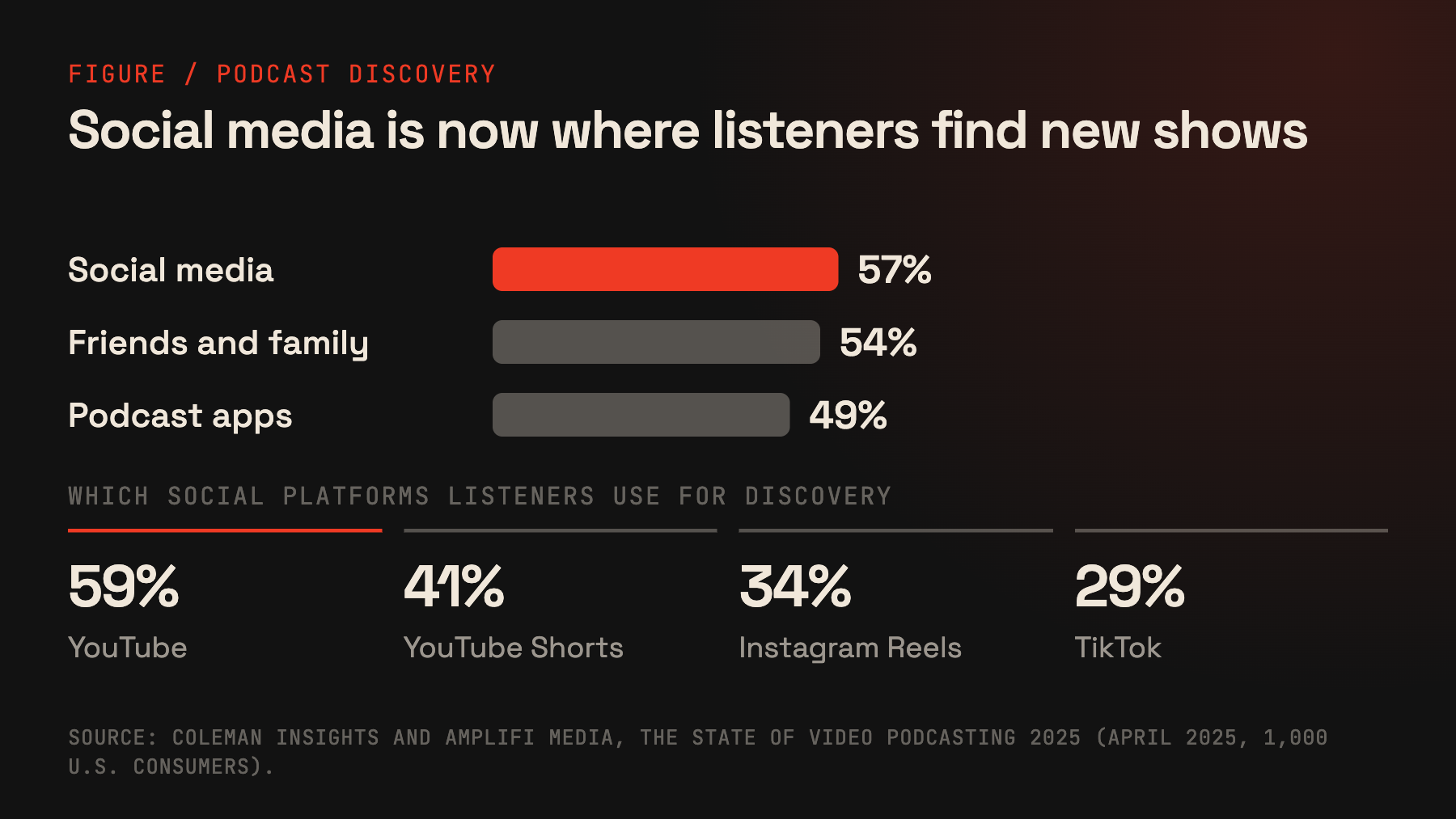
Treat it as one survey, commissioned by industry researchers, with a modest sample. It agrees with a larger signal from the platform side: YouTube said in February 2025 that it had passed 1 billion monthly active podcast viewers, and later reported more than 700 million hours of podcasts watched on living-room devices in October 2025, up from 400 million a year earlier. YouTube's viewer figure is global and counts any time spent, so it overstates what a typical show can capture. The direction is still clear.
Most clips fail before the first cut
Everyone who has seen a clip die knows the cause: the moment was good in the hour and dead on its own. A conversation builds context minute by minute, with rapport, setup, callbacks and shared jokes. A clip arrives with none of it, so a stranger meets a sentence that starts in the middle.
That is a video hook problem in its purest form. The viewer decides in roughly three seconds whether to stay, as the platform skip-rate and swiped-away metrics show, and a clip that opens with "and that is why it matters" has not told them what "it" is. A moment can be excellent and still be wrong to clip, because it depends on what came before.
The fix is a test applied before anything is cut. Read the first sentence of the candidate clip aloud to someone who has not heard the show. If they cannot say what the clip is about, the moment needs a different start, or it needs to stay in the episode.
Six kinds of clip hide in an hour
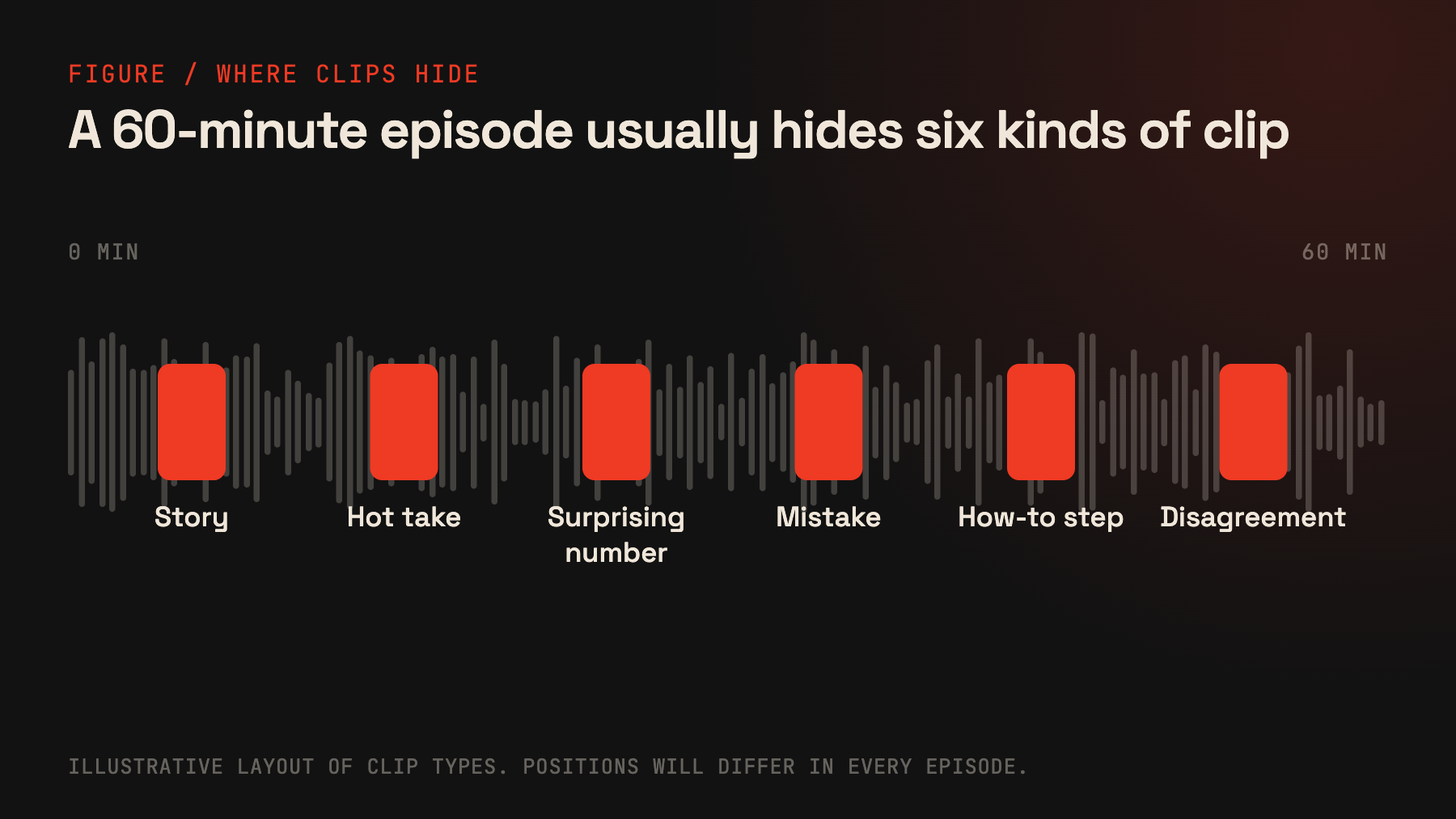
Standalone moments tend to fall into a short list. The table below is a way to read a transcript, and it comes from our editing practice rather than from research.
| Type | What to listen for | Why it travels |
|---|---|---|
| Story | A short anecdote with a beginning and an end | Complete on its own |
| Hot take | A clear opinion stated in a sentence | Easy to agree or argue with |
| Surprising number | A statistic that contradicts an assumption | Gives the hook for free |
| Mistake | A guest describing what went wrong | Honest, specific and useful |
| How-to step | One concrete instruction | Worth saving and sharing |
| Disagreement | Two people holding different views | Natural tension to resolve |
An hour of talk rarely holds all six, and rarely needs to. A show with a clear format finds the same two or three types repeatedly, which is useful because the editing choices become repeatable.
From seam to coin: the five stages
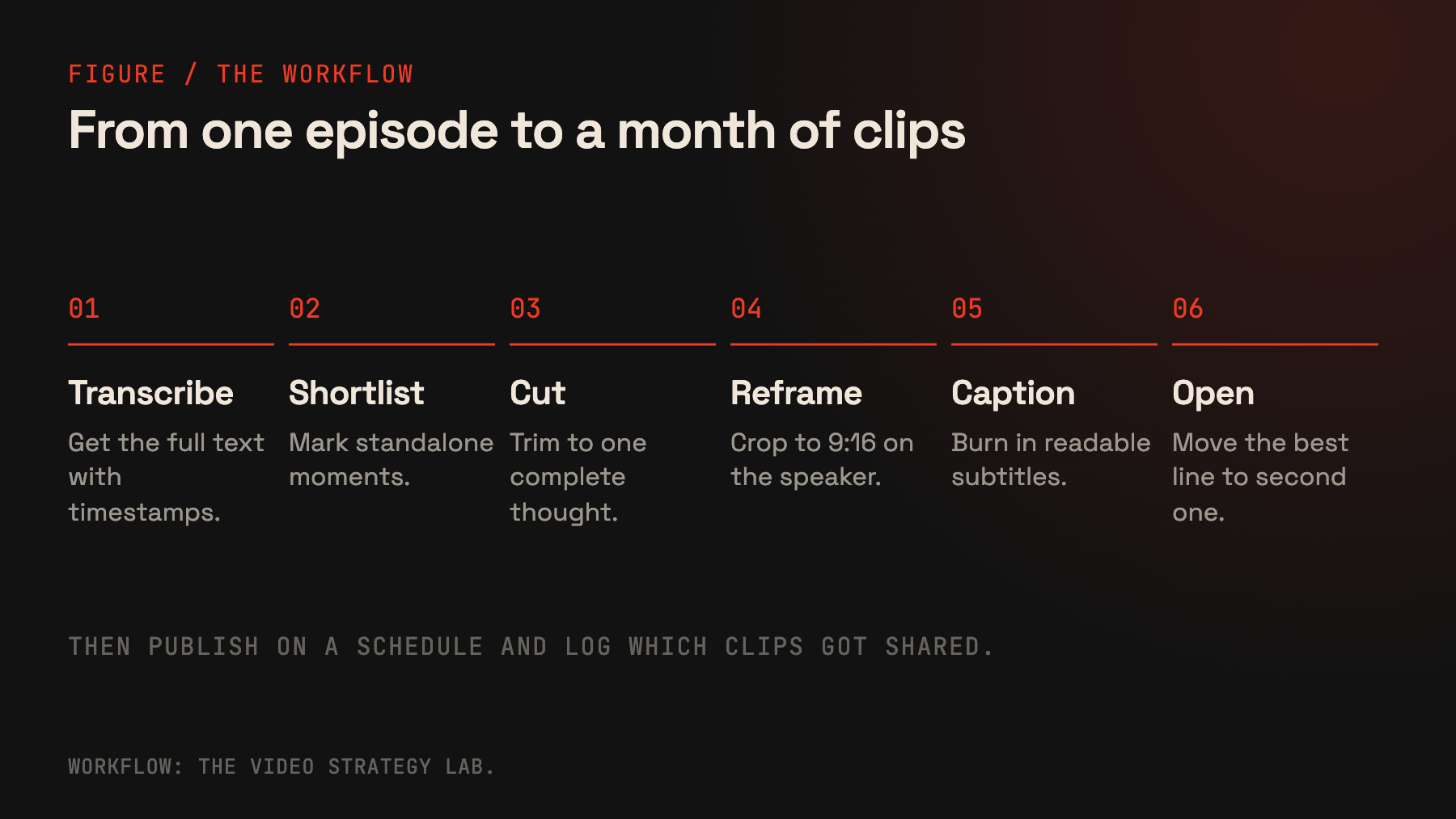
With the evidence in place, the picture that organises the workflow is mining. An episode is a seam. You survey it, drill it, test the samples, refine what survives and mint it into something that circulates.
Survey: transcribe
Get a full transcript with timestamps. Reading a transcript lets you scan an hour in minutes and mark candidates by line, which is easier than scrubbing audio.
Drill: shortlist
Mark eight to twelve candidates per hour using the six types above. Our rule of thumb is that about half survive testing. That is an editing habit, with no study behind it.
Assay: test for standalone value
For each candidate, ask three questions. Does the first sentence make sense cold? Is there a complete thought with an ending? Would someone outside your audience know what it means? Candidates that fail go back in the episode.
Refine: cut, reframe, caption, open
Trim to the thought, tighter than feels polite. Crop to 9:16 on the speaker, switching to whoever is talking in a two-person recording. Add captions that stay inside the safe area, as covered in our guide to Reels, TikTok and YouTube Shorts. Then move the strongest line to the first second.
Mint: publish and log
Schedule on a steady cadence and log which clips are shared and which are skipped. Eight clips at two a week covers a month from one episode, and the log tells you which types your audience wants more of.
Framing and sound: where talking-head clips are won
Two craft problems decide whether a clip that passes the assay looks professional. The first is framing. A podcast is usually shot as a wide two-shot, which crops badly to vertical because both faces end up small. The usual fix is to cut to the active speaker with a punch-in, and to hold on a listener's reaction only when the reaction is the point. The second is sound. Podcast audio is mixed for long listening, so levels that work in headphones can be too quiet or too dynamic on a phone speaker, and a short pass for volume, noise and breaths before export prevents the most common complaint.
Captions deserve a decision of their own. Keep them close to verbatim so they match what people hear, remove obvious filler, and break lines at natural phrases. These are craft choices from our editing practice, and the research above does not rule on them.
What a month of clips looks like
Eight clips at two a week is a cadence a show can sustain without turning into a clip factory. Here is an illustrative plan for one episode.
| Week | Clips | Focus |
|---|---|---|
| Week 1 | Surprising number, hot take | The strongest hooks first, while the episode is fresh |
| Week 2 | Story, mistake | Longer clips of 45 to 60 seconds for viewers who stay |
| Week 3 | How-to step, disagreement | Shareable and discussable moments |
| Week 4 | The two best performers, re-cut | Reopen the winners with a different opening |
The last row matters most. A clip that worked can be re-cut with another opening and posted again after a gap, which is cheaper than hunting for a new moment, and it is how the log from the mint stage pays off.
How to tell whether clips are working
Judge each clip on the number its platform reports for the opening: skip rate on Reels, viewed vs. swiped away on Shorts, and finishing on TikTok, as covered in our guide to Reels, TikTok and YouTube Shorts. Then look one step further for the outcome you want, which is new listeners. That step is hard, because platforms rarely show who went from a clip to an episode. The signals you can see yourself are a lift in episode plays or follows on the days a clip posts, listeners who mention a clip when they get in touch, and a tagged link in the post description. Expect imperfect attribution, read trends across several weeks instead of single clips, and compare clip types against each other, because that tells you which of the six your audience values.
What clipping a podcast should cost
Clips are short-form edits, so the same pricing logic applies. On our packs, eight Simple edits cost $400 a month, or $50 each, and Complex edits with advanced motion graphics cost $580 for eight. The full breakdown, including freelancer and in-house comparisons, is in short-form video editing cost.
AI clipping tools change part of the arithmetic. They can transcribe an episode and rank candidate moments quickly, and that covers the survey and drilling stages well. In our view, the assay stage still needs a person, because judging whether a moment stands alone depends on context a transcript cannot show. We compare the two approaches in AI video editing. If you want a service to run the whole workflow, our podcast clip editing does that, and our guide to video editing companies covers the alternatives.
The case for publishing the full episode only
The strongest objection is that clips misrepresent. A thirty-second excerpt strips the qualification, the joke or the follow-up that changed what a guest meant, and a show built on nuance can lose that nuance. Clips can also attract an audience that wants the hot take and not the hour, which shows up as strong views and weak listening.
Both risks are real. The Edison finding that most audiences now both listen and watch suggests the answer is a clip that works as a trailer rather than a replacement. Choose moments that stay true out of context, caption them accurately, and point to the full episode in the post. A clip that would mislead on its own should stay in the hour.
Back to the seam
That 62-minute file still has the same few minutes in it, and a stranger is scrolling past them right now. You can open the transcript of your last episode, mark eight candidates and read each opening line aloud to someone who has not heard the show. The ones that survive are your next month of clips.
Or you can send us the episode. Our podcast clip editing reviews the full recording, finds the moments worth posting, cuts them to a complete thought, reframes them for vertical and captions every clip so it works with the sound off. You get a batch back in 48 to 72 hours, ready for Reels, Shorts and TikTok, with two rounds of revisions. Packs start at $220 for four clips and there is no contract, so one episode is enough to see whether the workflow suits your show.