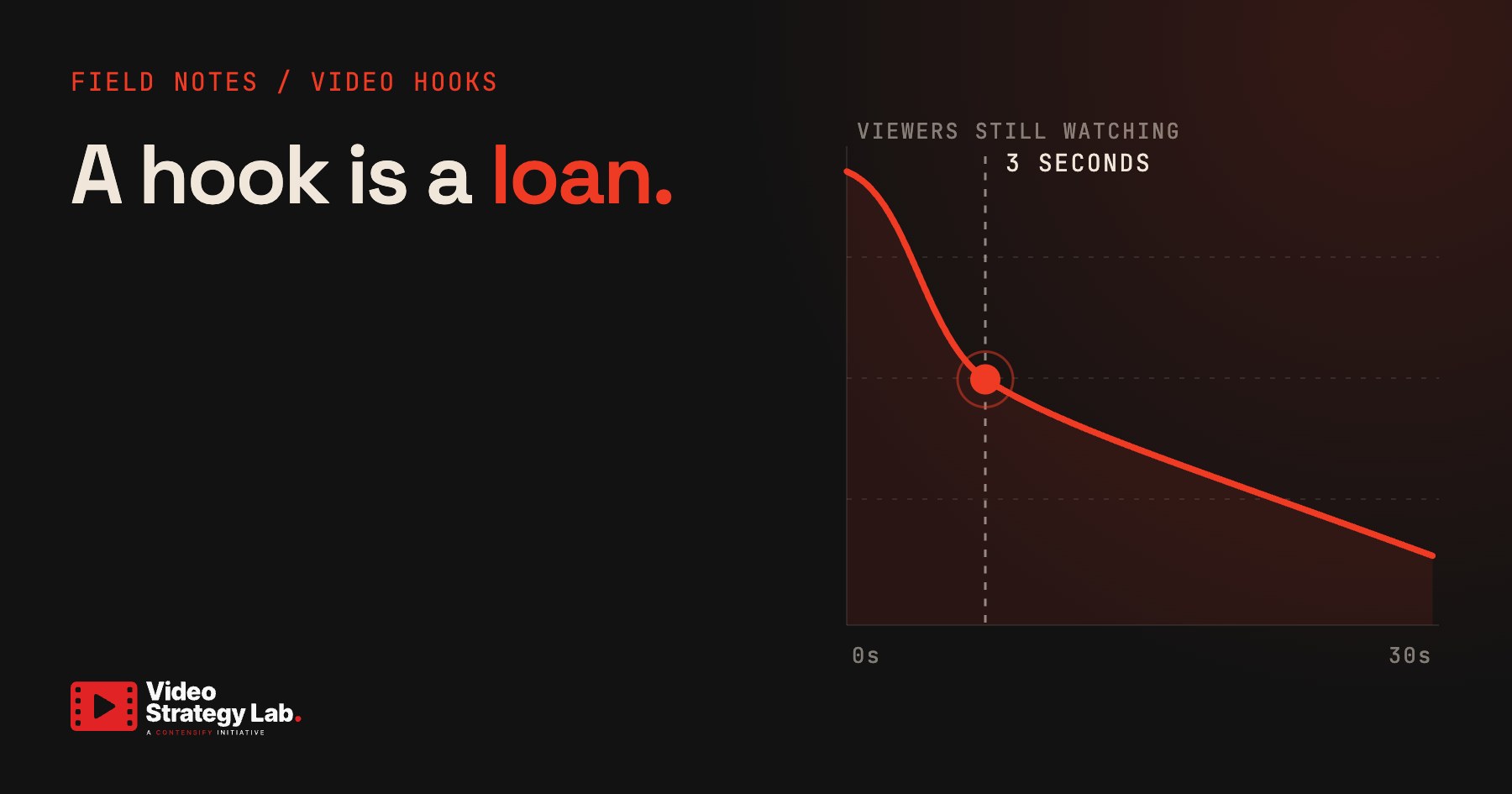
In August 2025, Instagram added one number to the insights page of every Reel. The number is called skip rate, and Instagram defines it as the percentage of views from people who decided to skip your reel during those first 3 seconds.
Read that definition again, because it describes a decision. Somewhere a stranger held a thumb over a screen, saw your first second, weighed it against the next video waiting underneath, and chose. Instagram now counts how often that choice goes against you.
The line, as it circulates: humans now have an attention span of eight seconds, shorter than a goldfish.
Repeated in marketing decks since 2015, usually credited to Microsoft
A hook is a loan of attention, and the rest of the video is the repayment.
Everything below works that sentence out. We edit short-form video for a living, so we have an interest in the claim that openings matter, and you should weigh the argument with that in mind. The numbers come from the platforms and from independent researchers, and each one is linked where it appears.
The goldfish never existed
The eight-second figure appeared in a 2015 report from Microsoft Canada's consumer insights team, which surveyed 2,000 Canadians and studied the brain activity of 112 people. The attention-span statistic was not one of its findings. It sat in the report with a citation to a website called Statistic Brain, and when the BBC's More or Less programme followed that citation in 2017, nobody could produce the research behind it. Fast Company's summary of the trail is the clearest we found. The goldfish half of the comparison fares no better, since there is little evidence that goldfish have unusually short attention spans or memories.
What researchers actually measure points somewhere less cartoonish. Gloria Mark, a psychologist at UC Irvine, has tracked how long people stay on one screen before switching since 2004. Her results: about 2.5 minutes in 2004, 75 seconds in 2012, and roughly 47 seconds in studies from the last five or six years, with other researchers landing at 50 and 44 seconds.
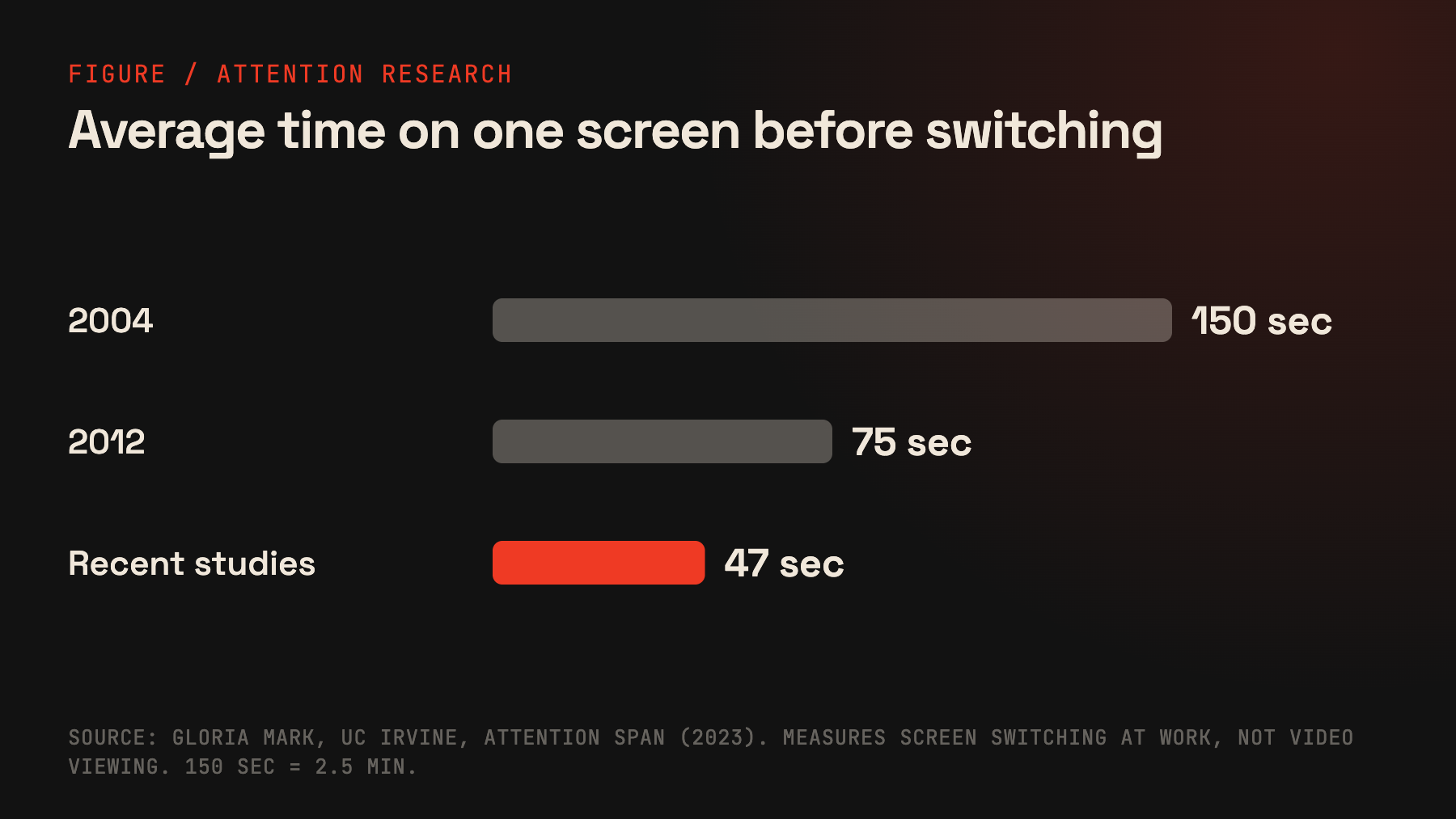
Two cautions keep that number honest. Mark's studies observed people at work, moving between windows, so they describe how fast people travel around a screen and say nothing direct about how long someone will watch a video that deserves it. An average also hides a spread: plenty of switches happen within seconds while a few stretches of focus run long.
The useful reading is that attention has not collapsed to eight seconds. It has become a ration that people review constantly. Viewers are not goldfish. They are lenders who check the account every few seconds, and a hook is what you offer when you ask for the first loan.
Three seconds is a measurement, not a law
Every major vertical platform now reports the first moment of a video as its own number, and the three reports line up closely enough to compare.
| Where | What it reports | What it tells you |
|---|---|---|
| Instagram Reels | Skip rate | Share of views skipped in the first 3 seconds (added August 2025) |
| YouTube Shorts | Viewed vs. swiped away | Share of feed impressions where people stayed instead of swiping, per the YouTube team's announcement |
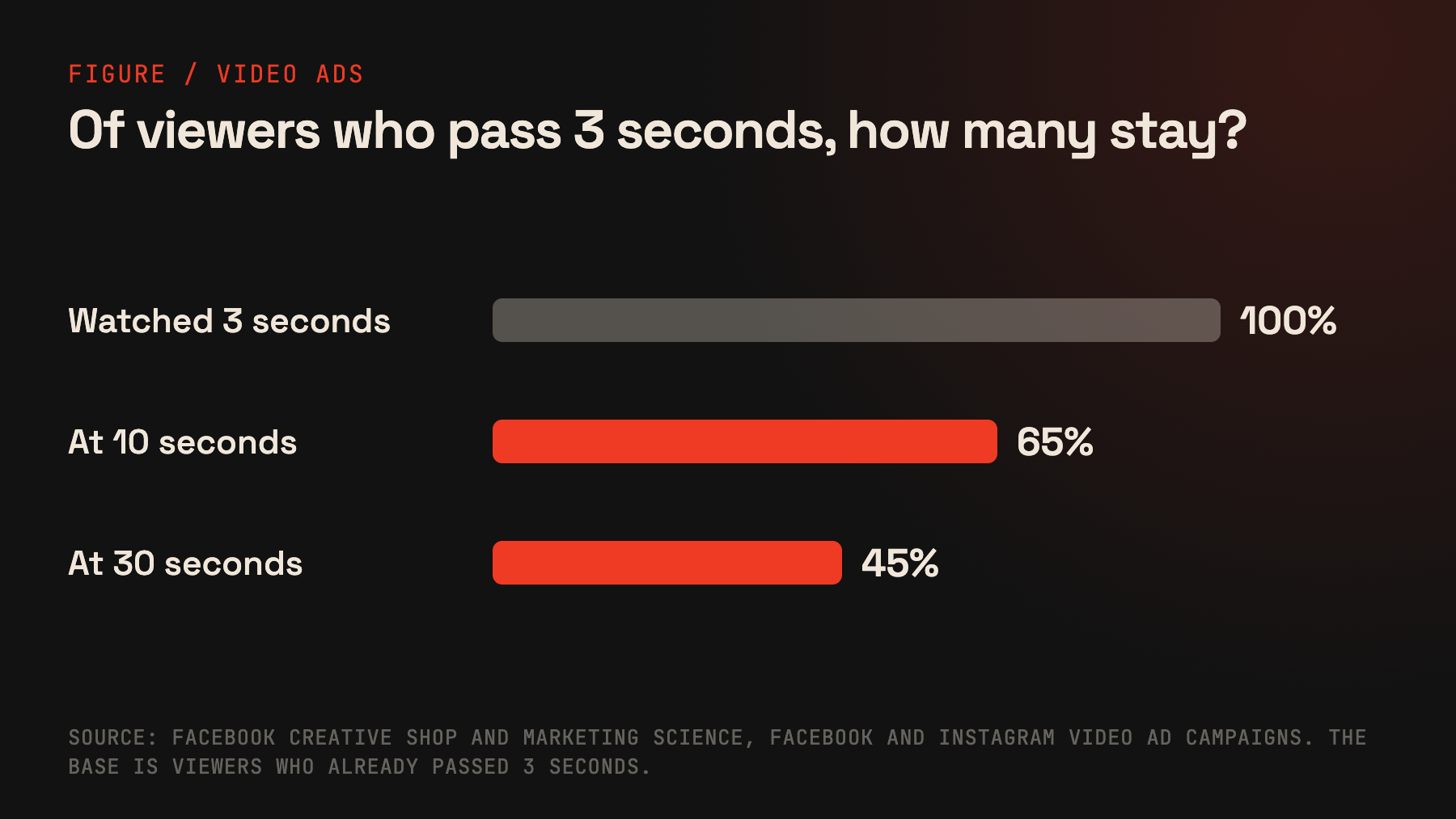
| Facebook and Instagram video ads | Continuation past 3 seconds | 65% of people who watch 3 seconds watch at least 10; 45% reach 30 |
The last row comes from Facebook's Creative Shop and Marketing Science teams, who drew it from their analysis of video ad campaigns. The page carries no date, so treat it as a durable pattern rather than a current benchmark. It also describes survivors: the 65% is a share of people who already passed three seconds. What it shows is that the first three seconds are the steepest filter, and that after them the crowd thins slowly.
Taken together, the platforms are reporting one decision three different ways. Because each reports it as a rate, a hook can be tested the way an email subject line is tested: change the opening, publish, compare the number.
Knowing the rule does not write the line
Most creators have heard about the first three seconds. Most openings still begin with a greeting, a throat-clear or a logo. Awareness has not fixed it, and the reason has a name.
In 1990, Elizabeth Newton, a Stanford psychology graduate student, asked people to tap out the rhythm of well-known songs for a listener to identify. Tappers predicted listeners would guess correctly about half the time. Across 120 songs, listeners guessed 3, which is 2.5%. The tapper hears the whole melody inside their head while the listener hears knocking on a table. Chip and Dan Heath later popularised the result as the curse of knowledge.
A creator reviewing their own opening is the tapper. They know what the video is about, who the guest is and why the story matters, so "Hey everyone, today I want to talk about" sounds like a perfectly reasonable start. A stranger hears knocking.
The correction is mechanical. Watch the first three seconds on mute, with no title and no caption, the way a stranger meets them. If you cannot say what is being offered, nobody else can either. A second pair of eyes helps for the same reason: someone who was never given the melody hears the knocking.
Anatomy of a loan
Before the metaphor, one piece of evidence on length. Wistia analysed more than 13 million videos and 79 million hours of viewing for its 2026 State of Video report and found that shorter videos achieve higher engagement rates, with videos under five minutes strongest. A shorter video asks for a smaller loan, so more people accept the terms and fewer default.
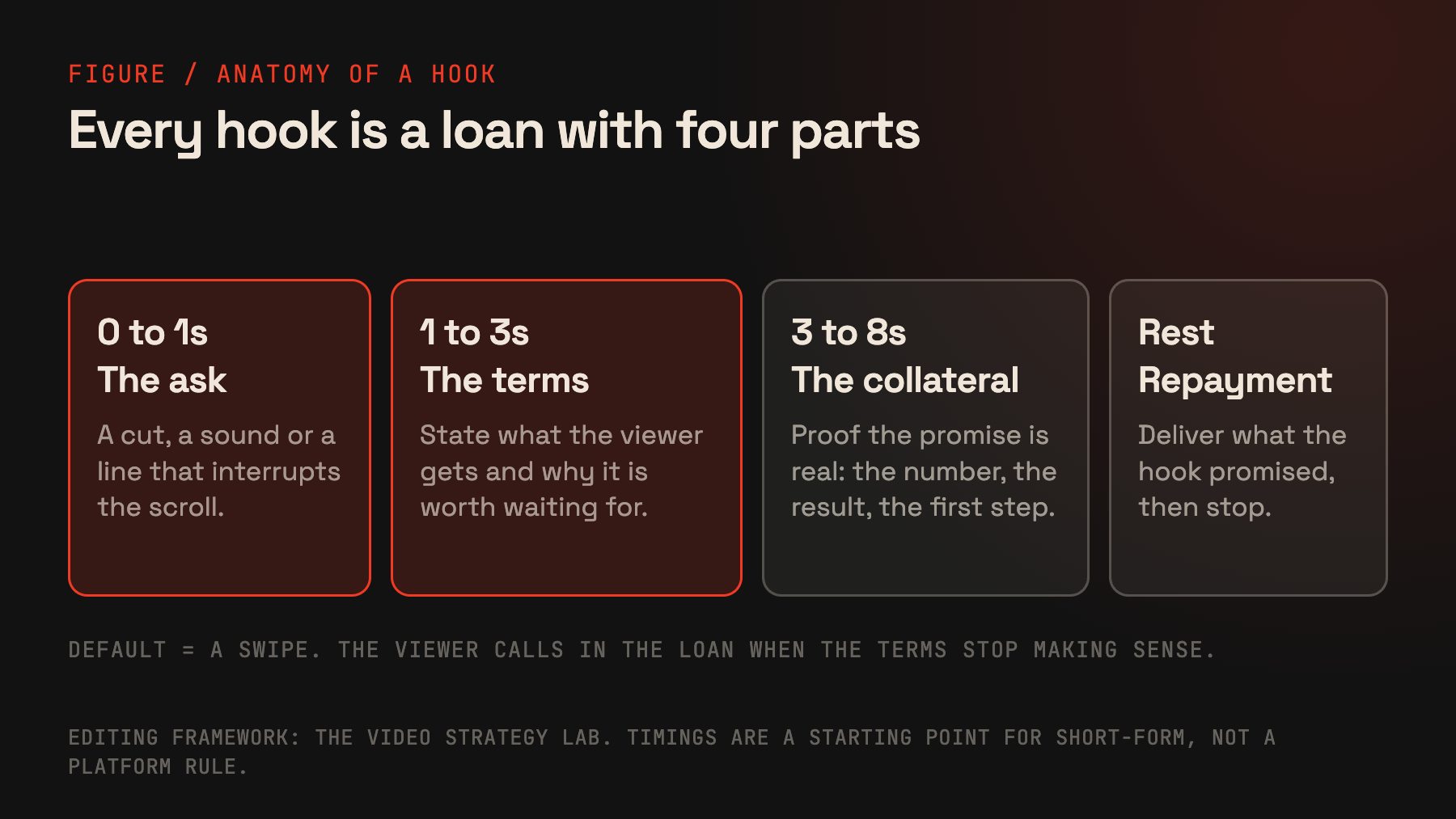
With that on the table, the framing that has served our editing best is that every hook is a loan with four parts.
The ask (0 to 1 seconds)
The viewer owes you nothing. The first beat has to interrupt whatever their thumb was doing: a cut, a sound, a face already mid-sentence, a line that starts in the middle of something. Greetings fail here because they ask for attention without giving a reason.
The terms (1 to 3 seconds)
The terms say what the viewer gets and roughly what it costs in seconds: "here is the one setting that fixes muddy audio." A loan with unclear terms gets declined. This is the line most scripts are missing, because the writer assumes the terms are obvious.
The collateral (3 to 8 seconds)
Collateral is proof that the promise is real: the finished result, the number, the first step on screen. It keeps a viewer who accepted the terms from reconsidering at second five.
Repayment (the rest)
Deliver what the hook promised, then end. A hook that promises a secret and delivers a plug is a default, and viewers remember it. The skip-rate and swiped-away numbers above only measure the first moment; the damage from a broken promise shows up later, in the retention curve.
The model has no research behind it beyond the evidence above. Its use is diagnostic: when a video loses people early, ask which of the four parts is missing.
Six hook patterns and what the edit does with each
Writers talk about hooks as lines. Editors know the line is half of it, because the first frame, the first caption, the first sound and the first cut all land inside the same three seconds. These are the patterns we reach for most. The example lines are illustrative.
| Pattern | Example line | What the edit does | Fails when |
|---|---|---|---|
| Result first | "This is the finished version. Here is what it took." | Opens on the best frame, then rewinds | The result is not visually clear |
| Contrarian claim | "Posting daily is the worst advice in video." | Captions the claim in frame one, cuts on the verb | The claim cannot be defended in ten seconds |
| Open loop | "There is one setting most editors never touch." | Lands a sound hit on the key noun, delays the reveal | The loop never closes |
| Mid-action start | "...and that is when the invoice arrived." | Trims all setup, starts on a verb | The viewer has no context at all |
| Specific number | "Forty-one takes for twelve seconds of video." | Puts the number on screen with the first word | The number feels arbitrary |
| Direct callout | "Posting three times a week and still stuck? Watch this." | Captions the audience label for muted viewers | The audience is too broad to feel addressed |
Notice what the edit column has in common: nothing in it adds length. Most hook work is subtraction. Cutting the first breath, the "so", the greeting and the second restatement of the topic often moves the actual opening from second four to second one without a single new word. Platforms weigh these early moments a little differently, which is the subject of our guide to Reels, TikTok and YouTube Shorts. The same patterns apply to long recordings, as in how podcast clips are cut from an hour of conversation.
The strongest case against the three-second rule
The best objection comes from storytellers and long-form creators, who point out that slow openings can work. A quiet, tense first shot has launched plenty of films, and some audiences, particularly on long-form YouTube, will tolerate a patient setup. A hook can also do damage. Promise too much and you collect views you cannot keep, which later appears as a collapsing retention curve.
Both points hold. A slow open is still a loan: it works when the viewer senses something worth waiting for, and tension, mystery and a striking image all count as terms. What fails in a feed is a slow open with no terms at all, because the alternative sits one swipe away at no cost. The over-promising hook is a failure of the fourth part, repayment, and says little against hooks as such. The rule that survives is narrower than the folklore: earn the next beat, and keep earning it.
How to test a hook
- Write three openings for each idea before filming, with at least one that starts mid-action.
- Publish variants as separate videos in similar time windows, changing only the opening.
- Read the right number. That is skip rate on Instagram and viewed vs. swiped away on YouTube Shorts.
- Keep a hook log of line, pattern, first frame and result. After ten entries you have a benchmark of your own.
- Judge patterns across several posts, since a single video is noisy.
Be wary of published targets. Third-party guides circulate numbers such as skip rates below 20% or viewed rates above 70%, but we could not find a platform that has published an official target, so treat your own recent average as the number to beat.
If you outsource editing, ask what the editor may change in the first three seconds. A vendor who only adds captions cannot move your skip rate much. We cover what to ask in our guide to video editing companies and what the work should cost in short-form video editing cost.
Back to the number
Skip rate is the dashboard's way of telling you how many strangers declined the loan. Each of them looked at your first second and made a sensible call with the information you gave them. You can spend the next month testing openings on your own footage, or you can hand the recordings to editors who treat the first three seconds as the job.
That is what we do. Every video we edit is built around where viewers drop off: an opening that states its terms straight away, pacing that keeps earning the next beat, and captions placed inside the safe area. Your edit comes back in 48 to 72 hours, packs start at $220 for four videos, revisions are included, and there is no contract to sign. Send us one recording and see what your first three seconds look like when somebody has edited them on purpose.